Food for Food Pantry: What to Donate and What to Skip
At Feeding San Diego, we accept food donations from the community during our normal business hours. However, it’s not as simple as pulling the almost-expired cans from your cupboards and dropping them off. The best food for food pantry donations is shelf-stable: canned meals, canned protein, peanut butter, cereal, and cooking staples. A few simple guidelines help ensure your donation goes straight to the people who need it. This guide covers what to give, what to leave at home, and what happens after you drop off.

Food from a food drive
What to Donate to a Food Pantry
The short answer is: non-perishable foods. Dry goods, canned foods, and other shelf-stable items can all be donated at our Sorrento Valley headquarters. The items we need most are the ones families can turn into a meal right away:
- Ready-to-eat meals like canned soup or pasta
- Meal ingredients like Hamburger Helper
- Cooking oils, condiments, and spices
- Canned protein like tuna, chicken, and spam
- Peanut butter
- Cereal
Pop-top cans are preferred because not everyone has a can opener at home.
If you are hosting a food drive, we recommend choosing one item from this list and focusing on it. A drive built around peanut butter, for example, fills a real gap on our shelves.
What Not to Donate
We cannot accept perishable food or items in glass jars. Expired or opened items can’t be distributed either, so check dates before you pack a bag.
We do have many partners who can accept fresh food. You can use our Find Food Map to locate a partner near you and call ahead to ask what they take.
How to Drop Off Your Food for Food Pantry Donations
Once you’ve collected all your donations, your next steps are:
- Gather your donation and check that every item is unopened, unexpired, and not in glass.
- Bring it to our Distribution Center at 9477 Waples St., Suite 100, San Diego, CA 92121.
- Drop off Monday through Friday between 8 a.m. and 4:30 p.m.
- Ask our team for a donation receipt. We provide one for tax purposes.
We cannot pick up food donations, so all donations must be dropped off.
If you run a food business with surplus product, such as a manufacturer, grocery store, or grower, our food sourcing team arranges those larger donations. Learn more on our Donate Food page.
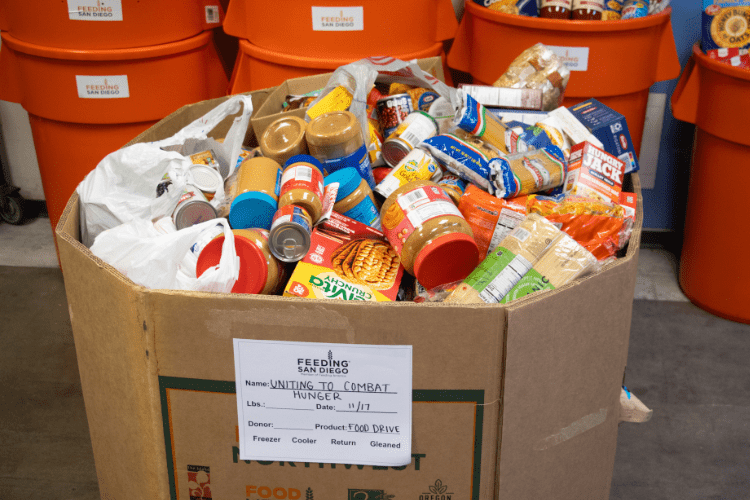
A tote filled with food gathered by a food drive
What Happens to Your Donation
All donated food we receive is sorted before being distributed to the community. Our volunteers sort and glean everything, ensuring it is safe to eat and helping prepare it for distribution.
Single items, such as one can of beans, go to the Feeding San Diego Marketplace. Multiple items of the same type are bundled into pallets and used at our food distributions throughout the county. To see how those distributions work, read our guide to the types of food distributions in San Diego County.
Collecting Food with Friends, Coworkers, or Neighbors
A food drive turns a few cans from each person into a full pallet. You can collect physical items, raise funds online, or do both. Our step-by-step guide to starting a food drive in San Diego covers the request form, the flyer, and ideas for schools, workplaces, and neighborhoods.
Give a Gift, Provide Meals
Not everyone can shop and drive to Sorrento Valley, and a financial gift goes a long way. Because we work with food manufacturers, retailers, and farmers, every $1 donated helps provide two meals. A can of beans can cost about a dollar at the store. That same dollar, given to Feeding San Diego, becomes two meals for a neighbor in need. Donate today.
Questions about your donation? Email info@feedingsandiego.org, and our team will be happy to help.
Need Food Support?
If you or someone you know needs help, use the Find Food Map to locate free food near you, or call our CalFresh team at 858.863.6635 to find out whether you qualify for food benefits.