How to Start a Food Drive in San Diego: A Step-by-Step Guide for Individuals, Schools, and Businesses
Starting a food drive in San Diego is one of the most direct ways to help your neighbors facing hunger. Between July 2025 and June 2026, Feeding San Diego provided more than 43 million pounds of food – the equivalent of more than 36.2 million meals – to people experiencing hunger across the county. That supply is built in part by community members like you: individuals, schools, workplaces, and faith communities who take it on themselves to collect food and funds for their neighbors. Whether you have a small office or a large congregation behind you, here’s everything you need to know to run an effective food drive in San Diego.
Why San Diego Needs Food Drives Right Now
Nearly 430,000 people in San Diego County are food insecure, including more than 123,000 children. Food insecurity can affect anyone – a neighbor, a coworker, a kid on your child’s soccer team, a senior living on a fixed income in a rural part of the county. Many people are just one crisis away from needing support.
Feeding San Diego rescues surplus food from local grocery stores, farms, and food manufacturers before it goes to waste. Our network averages 1,000 pickups per week from food donors across the county. Community food drives play a different, equally important role. They collect nonperishable staples that go directly to neighbors through the Feeding San Diego Marketplace and partner distributions. At a time when food insecurity in San Diego County has surpassed pandemic-era peaks, every box of peanut butter and every can of soup counts.
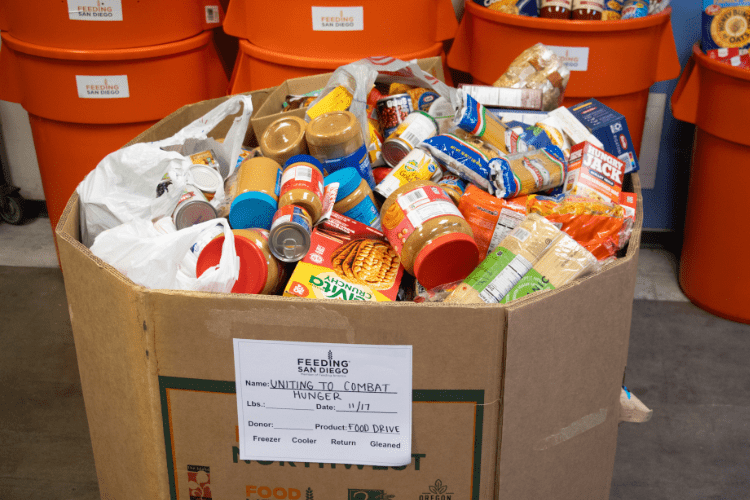
The results of a food drive in San Diego
Traditional Food Drive or Virtual Food Drive: Which Is Right for You?
Both formats make a real difference. The right choice depends on your group and how you want to involve people.
Traditional food drives collect nonperishable items, such as canned goods, dry goods, and shelf-stable foods, at one or more drop-off locations. Once the drive ends, you deliver donations directly to Feeding San Diego’s distribution center in Sorrento Valley. This format works well for schools, offices, apartment buildings, and faith communities where people can physically bring items to a central spot.
Virtual food drives collect funds online instead of physical goods. Because Feeding San Diego works with food manufacturers, retailers, and farmers to source food at scale, every dollar donated helps provide two meals to the community. As a result, a virtual drive is an efficient option for groups whose networks are spread out or who want to reach people beyond their immediate neighborhood. You can join Feeding San Diego’s virtual food drive or start your own fundraiser page.
The two formats work well together. A single campaign can collect canned goods at a drop-off location while also running an online fundraiser for people who prefer to give digitally.
What to Collect and What to Skip
Feeding San Diego accepts nonperishable food donations during normal business hours. Our most needed items are:
- Ready-to-eat meals like canned soup, chili, and pasta
- Meal ingredients like Hamburger Helper-style boxed meals
- Cooking oils, condiments, and spices
- Canned protein: tuna, chicken, Spam
- Peanut butter
- Cereal
Please note: we cannot accept perishable food or items in glass jars. Pop-top cans are preferred over cans that require a can opener.
One tip that makes a big difference: focus on a single item. A pallet of one product type is more efficient to sort and distribute than a bin of miscellaneous cans. Before you launch, fill out our Food Drive Request Form, and our team will let you know which item is the highest priority at that moment.
For a full breakdown of what to donate and how it gets used once it arrives, read: Answering Your Questions about Food for Food Pantry Donations.
How to Start Your Food Drive
- Fill out the Food Drive Request Form. Before you launch, connect with our team. We’ll share what’s most needed right now and help coordinate the details.
- Choose your format. Traditional, virtual, or a combination of both – pick what works for your audience and your logistics.
- Pick one item to focus on. A single-item drive is easier to promote and more efficient once donations arrive. Ask our team which item is the highest priority when you submit your form.
- Set a collection window. Two to four weeks is usually long enough to build momentum without losing steam.
- Promote it. Make flyers, post on social media, and tell people exactly where to drop off donations and what to bring. You can also use our downloadable food drive flyer. Tag @feedingsandiego, and we may share your drive on our channels.
- Add a fundraising option. Some participants can’t bring food but can give online. Set up a virtual fundraiser page alongside your physical collection.
- Deliver the donations. Drop off at 9477 Waples St., Suite 100, Sorrento Valley, Monday through Friday, 8 a.m. to 4:30 p.m. A donation receipt for tax purposes will be provided. Note: Feeding San Diego cannot pick up food drives.
- Thank your community. Share how many pounds were collected. Post photos. Tag @feedingsandiego. The more specific and celebratory your follow-up, the more likely people are to join again next time.
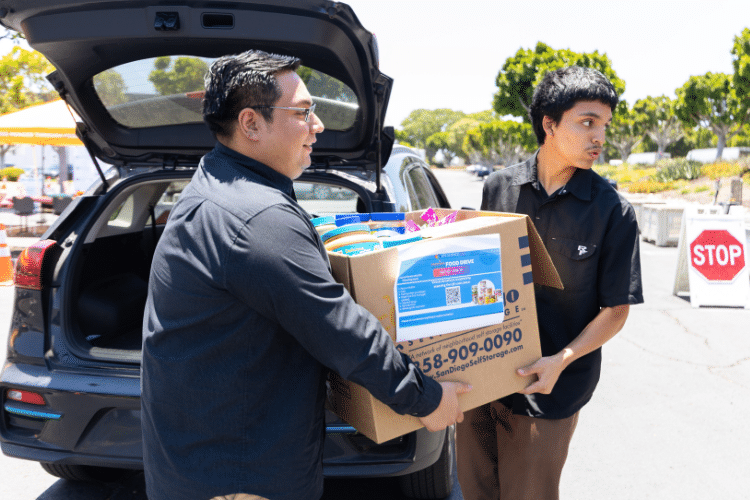
A delivery from the Life Science Cares food drive
Food Drive Ideas for Every Setting
Workplace food drives are among the easiest to organize. Set up a collection bin near the break room and challenge departments to compete for the highest contribution. October and November are a natural fit, aligning with Feeding San Diego’s Month of a Million Meals campaign. For companies interested in a longer-term partnership, learn more about our corporate partnership opportunities.
School food drives give students a hands-on way to support their community. Student councils and service-learning programs can manage logistics while building real civic skills. Schools already connected to a Feeding San Diego school pantry are especially well-positioned, as students know firsthand what food support means to families in their community.
Faith community drives tend to generate a strong response when tied to a meaningful moment in the community calendar. The Thanksgiving and winter holiday window (October through December) consistently brings the highest response for food drives.
Neighborhood and apartment drives can be as simple as a bin in the lobby and a notice in the HOA newsletter. Our Sorrento Valley distribution center is easy to reach from communities in Mira Mesa, Carmel Valley, Rancho Bernardo, and across North County.
Virtual drives can be set up in minutes. Start a fundraiser here and share the link with your network.
Ready to Start Your Food Drive in San Diego?
A food drive doesn’t require a large organization or months of planning. It requires people who care about the place they live and the people they live alongside. Fill out our Food Drive Request Form, and our team will be in touch to help you get started.
If giving funds is a better fit for you, every dollar donated to Feeding San Diego helps provide two meals to your neighbors facing hunger.